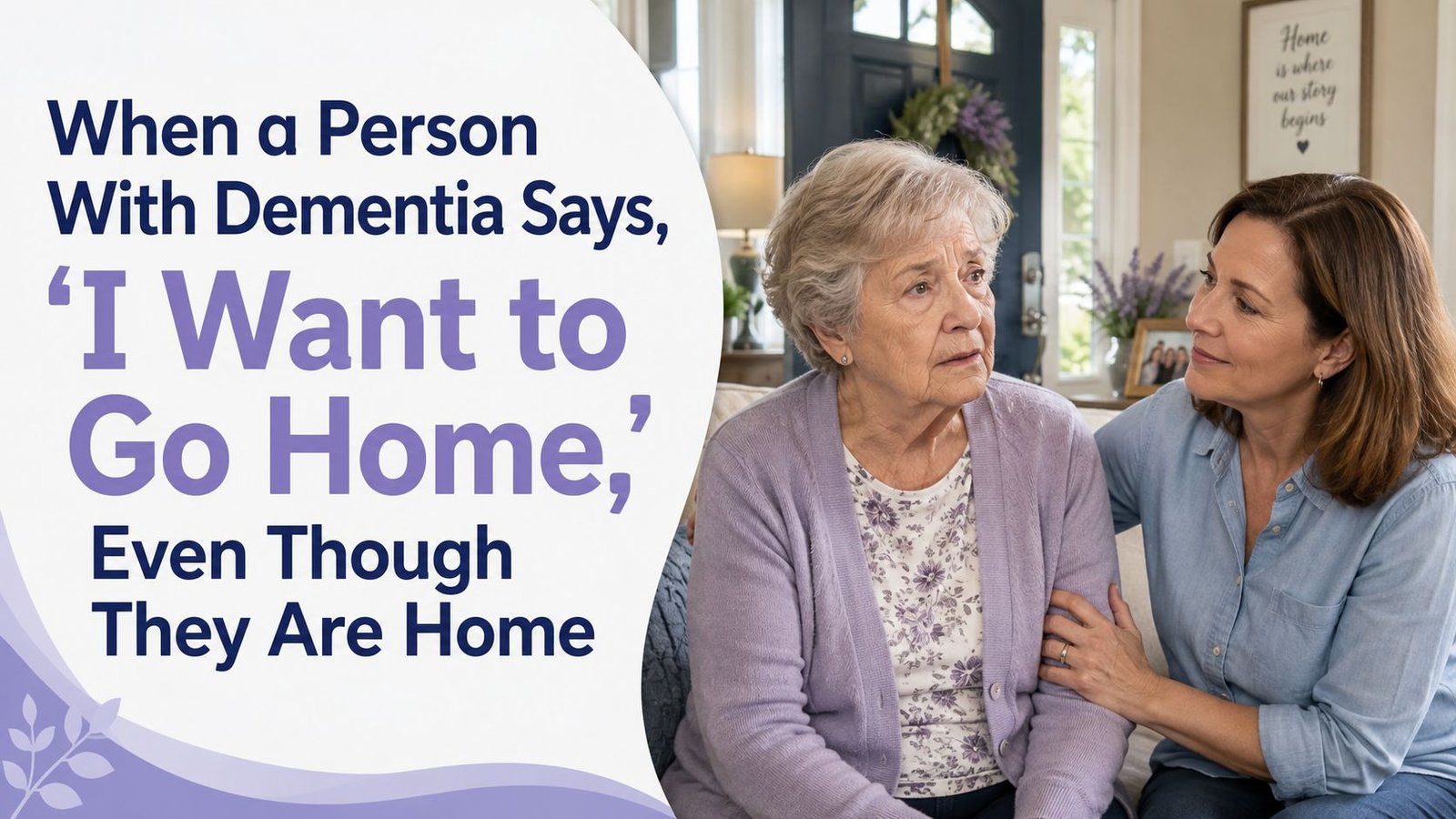
When a person living with dementia says, “I want to go home,” the words can hit a caregiver harder than expected.
They may be sitting in the same house where they have lived for decades. Their favorite chair is nearby. Family photographs hang on the wall. Everything appears familiar.
Yet they insist:
“This is not my home.”
“Please take me home.”
“My parents are waiting for me.”
A caregiver’s first instinct may be to correct them:
“You are home. You have lived here for 30 years.”
Unfortunately, facts may not resolve the distress. They can sometimes make the person feel more confused, dismissed, or trapped.
When someone with dementia asks to go home, “home” may not mean a specific address. It may represent safety, familiarity, belonging, comfort, or a time in life when the world made more sense.
The most helpful response is usually not proving where they are. It is understanding what they may be trying to communicate.
The Quick Answer
A person with dementia may ask to go home even when they are already home because they no longer recognize their surroundings, are remembering a home from an earlier period of life, or are trying to express fear, loneliness, discomfort, or a need for security.
Rather than arguing or repeatedly explaining that they are already home:
- Acknowledge the feeling behind the request.
- Reassure them that they are safe.
- Ask gentle questions about what “home” means to them.
- Check for pain, hunger, fatigue, overstimulation, or another unmet need.
- Redirect them toward a familiar and calming activity.
- Watch for exit-seeking or wandering.
- Seek medical guidance when the behavior begins suddenly or changes significantly.
According to the Alzheimer’s Society, understanding the feelings behind the request and exploring what the person means by “home” may be more useful than correcting them.
What Does “I Want to Go Home” Really Mean?
The word “home” carries more than a mailing address.
For many of us, home represents:
- Safety
- Familiarity
- Family
- Belonging
- Independence
- Predictability
- A sense of control
- A time when we understood our surroundings
Someone living with dementia may use “home” as shorthand for any of these feelings.
They may not have the words to say:
“I feel frightened.”
“Nothing here feels familiar.”
“I do not know what is happening.”
“I miss my mother.”
“I want to feel safe again.”
The location may not be the real problem. The emotion beneath the request may be the real message.
Why Might Someone Not Recognize Their Own Home?
Dementia can affect memory, visual processing, orientation, recognition, communication, and the ability to connect present surroundings with past experience.
Several factors may be involved.
They May Be Remembering an Earlier Home
Older memories may remain more accessible than recent ones.
A person may be thinking about:
- The house where they grew up
- Their first home after marriage
- A home where they raised their children
- Their parents’ house
- A place connected with security and belonging
They may believe they are much younger than they are now. From their perspective, their parents may still be alive, their children may still be young, and the place they currently live may seem unfamiliar.
The request to go home may actually mean:
“I want to return to the place and time that still feels real to me.”
They May No Longer Recognize the Current Environment
Even a longtime home can become unfamiliar when the brain has difficulty recognizing rooms, furniture, or spatial relationships.
Changes to the environment can make this worse, including:
- New furniture
- Remodeling
- Rearranged rooms
- Different lighting
- Clutter
- Unfamiliar visitors
- Holiday decorations
- A new caregiver
- Reflections in mirrors or windows
- Moving from one room to another after dark
The physical home may be the same, but the person’s experience of it has changed.
They May Feel Anxious or Unsafe
“I want to go home” frequently appears during moments of uncertainty.
The person may feel:
- Afraid
- Lonely
- Overwhelmed
- Confused
- Abandoned
- Trapped
- Uncomfortable
- Unsure what is expected of them
Trying to prove that they are already home may not touch any of those feelings.
They May Be Looking for Someone
The request may be connected to a person rather than a place.
They may want to find:
- A parent
- A spouse
- Their children
- A sibling
- A longtime friend
For someone whose memories place them in an earlier chapter of life, “going home” may mean returning to the people who made them feel protected.
They May Have an Unmet Physical Need
A person may not be able to clearly explain that they are:
- Hungry
- Thirsty
- Tired
- In pain
- Constipated
- Too warm or too cold
- Needing the bathroom
- Overstimulated
- Uncomfortable in their clothing
- Frightened by noise or activity
“I want to go home” may be the closest available phrase for:
“I need this situation to change.”
They May Be Experiencing Sundowning
Some people with dementia become more confused, restless, or distressed in the late afternoon or evening.
Fatigue, shadows, reduced lighting, disruption to routine, hunger, and accumulated stimulation may all contribute.
A request to go home that appears at roughly the same time each day may be part of a larger evening pattern.
How Should You Respond?
There is no sentence guaranteed to work every time. What helps one person may frustrate another, and the same person may respond differently from one day to the next.
Think of these strategies as tools rather than scripts carved in stone.
1. Pause Before Correcting Them
When someone says, “I want to go home,” avoid immediately replying:
“You are home.”
That statement may be factually correct, but if they do not recognize the house, it will not feel true to them.
Instead, pause and observe:
- Are they frightened?
- Are they pacing?
- Are they looking for someone?
- Are they gathering belongings?
- Did something happen just before the request?
- Is the room noisy or crowded?
- Is it late in the day?
Their tone, facial expression, and body language may tell you more than the words.
2. Validate the Feeling
Validation does not require agreeing that the current house is not their home. It means acknowledging that their emotion is real.
You might say:
“You really want to go home.”
“It sounds like you are missing home.”
“You seem worried. I am here with you.”
“Home must feel very important to you right now.”
This approach communicates that you are listening rather than preparing for a debate.
For a deeper look at this communication style, read Effective Communication: The Validation Method for Dementia Care.
3. Offer Reassurance
After acknowledging the feeling, offer a short statement of safety.
Examples include:
“You are safe here with me.”
“I will stay with you.”
“We are going to take care of everything.”
“You do not have to figure this out alone.”
Keep your voice calm and your sentences short.
Someone with dementia may have difficulty processing a long explanation, especially when anxious. Your tone and body language may carry more comfort than the exact words.
4. Ask What They Miss About Home
Rather than challenging the request, gently explore it.
Try asking:
“Tell me about your home.”
“What do you like most about being there?”
“Who is at home?”
“What does your kitchen look like?”
“Did your home have a porch?”
“What would you like to do when you get there?”
Their response may reveal the underlying need.
For example:
- “My mother is there” may point to a need for comfort.
- “I have to cook dinner” may reflect identity and responsibility.
- “The children will be home soon” may connect to an earlier stage of life.
- “I need my own bed” may signal fatigue or physical discomfort.
Do not turn the conversation into an interrogation. One gentle question may be enough.
5. Join the Memory Without Testing It
When the person begins talking about a former home, allow the memory to become a bridge rather than a test.
You might say:
“It sounds like that was a special place.”
“Your mother made you feel safe.”
“You worked hard to make that house a home.”
“Tell me about the meals you used to cook there.”
Old photographs, familiar music, meaningful objects, and memory boxes may help transform distress into connection.
Our guide, Unlocking Memories: The Power of Reminiscence Therapy and Memory Boxes, offers practical ideas for using personal history without turning the interaction into a memory quiz.
6. Check for an Immediate Need
Before redirecting, quietly run through the basics.
Could they need:
- The bathroom?
- A drink?
- A snack?
- Pain relief that has been prescribed?
- A warmer or cooler room?
- A quieter environment?
- Rest?
- A familiar person?
- Better lighting?
- Relief from tight or uncomfortable clothing?
Try offering one simple option at a time:
“Let’s use the bathroom first.”
“Would you like a cup of tea?”
“You look tired. Let’s sit somewhere comfortable.”
“It is noisy in here. Let’s go to the quieter room.”
Addressing the real need may reduce the urge to leave.
7. Redirect Gently
After validating and reassuring, guide the person toward something familiar.
You might say:
“We can talk about going home after we have some tea.”
“Before we leave, would you help me fold these towels?”
“Let’s sit down and look at your photo album.”
“Come listen to this song with me.”
“Let’s take a little walk together.”
Helpful activities may include:
- Listening to familiar music
- Looking through photographs
- Folding laundry
- Having a favorite snack
- Walking in the yard
- Watering plants
- Sitting on the porch
- Watching a familiar program
- Sorting safe household objects
- Holding a comforting item
- Calling a trusted family member
Redirection is most effective when it feels natural. A sudden, forced subject change may make the person feel dismissed.
8. Use Delay Without Making Promises You Cannot Keep
Sometimes a calm delay can give the feeling time to pass.
Examples include:
“It is too late to travel right now. We can look at it in the morning.”
“Let’s have dinner first, and then we will talk about the plan.”
“The weather is not good for driving. Let’s get comfortable here for now.”
Avoid creating complicated stories that you will have to remember or defend later.
The goal is not to outsmart the person. It is to reduce distress without creating another confrontation.
9. Try a Brief Change of Scene
In some situations, moving to another room, stepping onto the porch, or taking a supervised walk may help reset the moment.
A short drive can occasionally help some families, but it is not appropriate for everyone. Consider the person’s mobility, agitation level, tendency to exit the vehicle, and overall safety.
Never use a drive as the default response if getting into or out of the vehicle creates risk.
Sometimes the simplest reset is:
“Let’s walk together and get some fresh air.”
Helpful Responses to “I Want to Go Home”
When They Seem Frightened
“You are safe. I am staying right here with you.”
When They Miss Their Parents
“You are thinking about your parents. They made home feel safe.”
When They Believe Their Children Are Waiting
“You took wonderful care of your children. Tell me what they were like when they were little.”
When They Are Packing to Leave
“You want to make sure everything is ready. Let’s sit down and make a plan together.”
When the Request Happens at Night
“It is dark now, so we are staying somewhere safe tonight. Let’s get comfortable and rest.”
When They Are Angry
“I can see that this is upsetting. I am not going to argue with you. I am here to help.”
When You Do Not Know What to Say
“Tell me what you miss most about home.”
That one question can open a door that correction keeps slamming shut.
What Usually Makes the Situation Worse?
Arguing About the Facts
Statements like these may increase distress:
“This is your home.”
“You are not making any sense.”
“Your parents have been dead for years.”
“We have already discussed this.”
The person may feel cornered, frightened, humiliated, or disbelieved.
Asking Them to Prove What They Remember
Avoid questions such as:
“What is your address?”
“Don’t you recognize your own furniture?”
“How can you not know where you are?”
These questions turn confusion into failure.
Taking the Request Personally
Hearing “I want to go home” can feel like rejection, especially when you have worked hard to make the person comfortable.
It may sound like:
“I do not want to be here with you.”
That is not necessarily what the person is communicating.
They may be reaching for safety, identity, familiarity, or someone from their past. The request is usually about what they need, not a verdict on the care you provide.
Blocking the Door While Arguing
If the person is trying to leave, standing directly in their path or physically confronting them may increase panic or aggression.
Prioritize safety, but use space, calm language, redirection, and assistance from another caregiver when possible.
If there is immediate danger, contact emergency services and explain that the person is living with dementia.
Overloading Them With Explanations
A detailed timeline of when they moved, who owns the house, and why they must stay is unlikely to settle a distressed brain.
This is one of those moments when fewer words often carry more weight.
When “I Want to Go Home” Becomes an Exit-Seeking Risk
A verbal request can sometimes progress into attempts to leave.
Watch for:
- Pacing near doors
- Testing locks
- Gathering a coat, purse, or keys
- Packing belongings
- Waiting near an exit
- Saying they must catch a bus
- Trying to leave for work
- Searching for a spouse or parent
- Becoming increasingly agitated when redirected
- Leaving during the night
Do not assume the person will be unable to open a door because they struggled with it previously. Abilities can fluctuate, and familiar motor habits may remain.
The Alzheimer’s Association recommends adapting the home as abilities change. Safety measures may include better lighting, secured medications and hazardous items, monitored exits, and other individualized precautions.
Depending on the situation, families may consider:
- Door alarms or chimes
- Motion sensors
- Secure fencing
- Identification jewelry
- A current photograph
- Location-tracking technology
- Informing trusted neighbors
- Keeping car keys inaccessible
- A written missing-person plan
- Enrollment in an appropriate safe-return program
Safety tools should support the person without creating an unnecessarily restrictive or frightening environment.
What to Do if the Person Leaves or Goes Missing
If someone living with dementia is missing, act immediately. Do not wait for them to return on their own.
- Search the immediate home and property quickly.
- Check nearby roads, former homes, workplaces, favorite locations, and routes associated with past routines.
- Contact emergency services.
- Clearly state that the missing person has dementia.
- Provide a recent photograph, clothing description, mobility information, and likely destinations.
- Tell responders about medical conditions, medications, and communication needs.
The National Institute on Aging advises families to prepare for wandering and getting lost before an emergency occurs.
Look for Patterns
Keep a simple record of when the request happens.
Track:
- Time of day
- Who was present
- Noise level
- Meals and hydration
- Bathroom use
- Sleep
- Pain or illness
- Recent visitors
- Changes in routine
- Lighting
- What happened immediately beforehand
- Which response helped
You may discover that “I want to go home” appears:
- Near sunset
- When the primary caregiver leaves the room
- Before meals
- When the television is loud
- After visitors arrive
- When the person is tired
- When they need the bathroom
- After moving into a new care setting
- When they see a coat, purse, or doorway
- During a change in caregivers
Once you see the pattern, you can begin adjusting the environment before distress escalates.
How to Make the Current Environment Feel More Like Home
You may not be able to restore the exact place the person remembers, but you can increase familiarity.
Consider using:
- Family photographs
- A familiar chair or blanket
- Favorite music
- Meaningful artwork
- Familiar scents
- A recognizable bedspread
- Personal objects from earlier homes
- Clearly labeled rooms
- Consistent furniture placement
- Warm, even lighting
- A predictable daily routine
Avoid making several environmental changes at once.
What looks like a beautiful redesign to everyone else may feel like the house vanished overnight to someone living with dementia.
What if This Happens After Moving Into Memory Care?
Requests to go home are common after a move because nearly everything is unfamiliar.
The person may be adjusting to:
- New caregivers
- Different sounds
- An unfamiliar bedroom
- New routines
- Less privacy
- Different meal times
- Other residents
- Separation from family
- Loss of independence
Work with the care team to identify:
- The time of day the request occurs
- People or events that trigger distress
- Activities that calm the person
- Familiar objects to bring into the room
- Words and approaches that work at home
- Important parts of the person’s history
Consistency matters. Family members and staff should use a similar calm response rather than each person trying a completely different explanation.
When Should You Contact a Healthcare Professional?
A desire to go home can occur as part of dementia, but a sudden or severe change should not automatically be blamed on disease progression.
Contact a healthcare professional when the behavior:
- Begins suddenly
- Becomes much more frequent within hours or days
- Appears with unusual sleepiness or severe agitation
- Follows a medication change
- Occurs with fever
- Appears alongside urinary symptoms
- Occurs with reduced eating or drinking
- Follows a fall or head injury
- Appears with significant pain
- Is accompanied by a major change in walking, speech, or alertness
- Creates a repeated risk of leaving unsafely
Sudden confusion or behavioral change may be related to infection, dehydration, pain, medication effects, delirium, or another medical concern that requires evaluation.
Call emergency services for immediate danger, a missing vulnerable adult, signs of stroke, serious injury, breathing difficulty, loss of consciousness, or severe behavioral escalation that cannot be managed safely.
What if Nothing Seems to Work?
Sometimes validation, reassurance, food, music, photographs, and redirection all fail.
That does not mean you handled the situation badly.
The person’s distress may be too strong in that moment, or they may be unable to explain the underlying need. Stay as calm as you safely can, reduce stimulation, and avoid adding more words to an already overloaded situation.
You may need:
- Help from another family member
- Guidance from the person’s healthcare professional
- A dementia care specialist
- An occupational therapist
- In-home support
- Respite care
- A review of the current care environment
- A more detailed safety plan
One caregiver cannot solve every moment through patience alone. Patience is valuable, but it is not a substitute for support.
When the Words Hurt the Caregiver
There is another side to this moment that is rarely discussed.
You may have created a safe home, rearranged your life, lost sleep, handled appointments, managed medications, and given more than anyone sees.
Then the person looks at you and says:
“I do not belong here. Take me home.”
That can hurt.
You are allowed to acknowledge that pain without making the person responsible for it.
The disease may have changed their recognition of place, time, and relationships. Their words may not reflect the bond you share or the quality of care you provide.
When guilt begins piling onto exhaustion, read Dealing With Caregiver Guilt: A Compassionate Guide for Dementia Care Partners.
You are not failing because you cannot reason dementia away. You are navigating a condition that can rearrange someone’s sense of reality while leaving their need for safety and love fully intact.
Home May Be a Feeling They Are Trying to Find
When someone with dementia says, “I want to go home,” they may not be asking for transportation.
They may be asking for comfort.
They may be searching for a parent, a familiar role, a safer time, or a version of themselves they can still recognize.
You may not be able to take them back to the house they remember. But through reassurance, familiarity, patience, and connection, you may still be able to help them find part of what “home” means.
Sometimes home is not the building.
Sometimes home is the feeling that someone understands, someone is staying, and they are not alone.
Frequently Asked Questions
Why Does Someone With Dementia Want to Go Home When They Are Already Home?
They may not recognize their current surroundings, may be remembering a home from earlier in life, or may be expressing fear, loneliness, fatigue, pain, or a need for security. “Home” often represents a feeling rather than a specific address.
Should I Tell Them They Are Already Home?
You can try gentle orientation if it does not cause distress. However, repeatedly insisting that they are already home may lead to arguments or greater confusion. Validation and reassurance are often more helpful.
Is It Wrong to Redirect or Delay Them?
Redirection can be compassionate when it reduces distress and preserves safety. The goal should not be manipulation. It should be helping the person move through a frightening moment without unnecessary confrontation.
Should I Take Them for a Drive?
A brief supervised outing may help some people, but it is not safe or practical in every situation. Consider mobility, agitation, vehicle safety, the time of day, and whether leaving could make the person more distressed.
What Should I Say When They Ask for a Parent Who Has Died?
Rather than repeatedly announcing the death, which may cause fresh grief, you can acknowledge the feeling:
“You miss your mother. She made you feel safe.”
You might then invite them to share a memory. Every person is different, so pay attention to which response brings comfort rather than distress.
Does Wanting to Go Home Mean It Is Time for Memory Care?
Not by itself. However, frequent exit-seeking, wandering, nighttime activity, unsafe behavior, or care needs that can no longer be managed at home may indicate that the current plan needs to be reassessed.
What if They Become Angry When I Stop Them From Leaving?
Avoid arguing or physically confronting them when possible. Use calm language, give them space, redirect them, and seek help from another caregiver. If anyone is in immediate danger, contact emergency services and explain that the person has dementia.
References
- Alzheimer’s Society: “I Want to Go Home” – What to Say to Someone With Dementia
- Alzheimer’s Association: Home Safety
- National Institute on Aging: Wandering and Getting Lost
- Alzheimer Society of Canada: How to Help With Wanting to Go Home
Medical Disclaimer
The information provided by DementiaHelp.io is for educational and informational purposes only and is not intended as medical advice, diagnosis, or treatment. Always consult a physician or another qualified healthcare professional regarding symptoms, sudden behavioral changes, medications, safety concerns, or other medical questions.