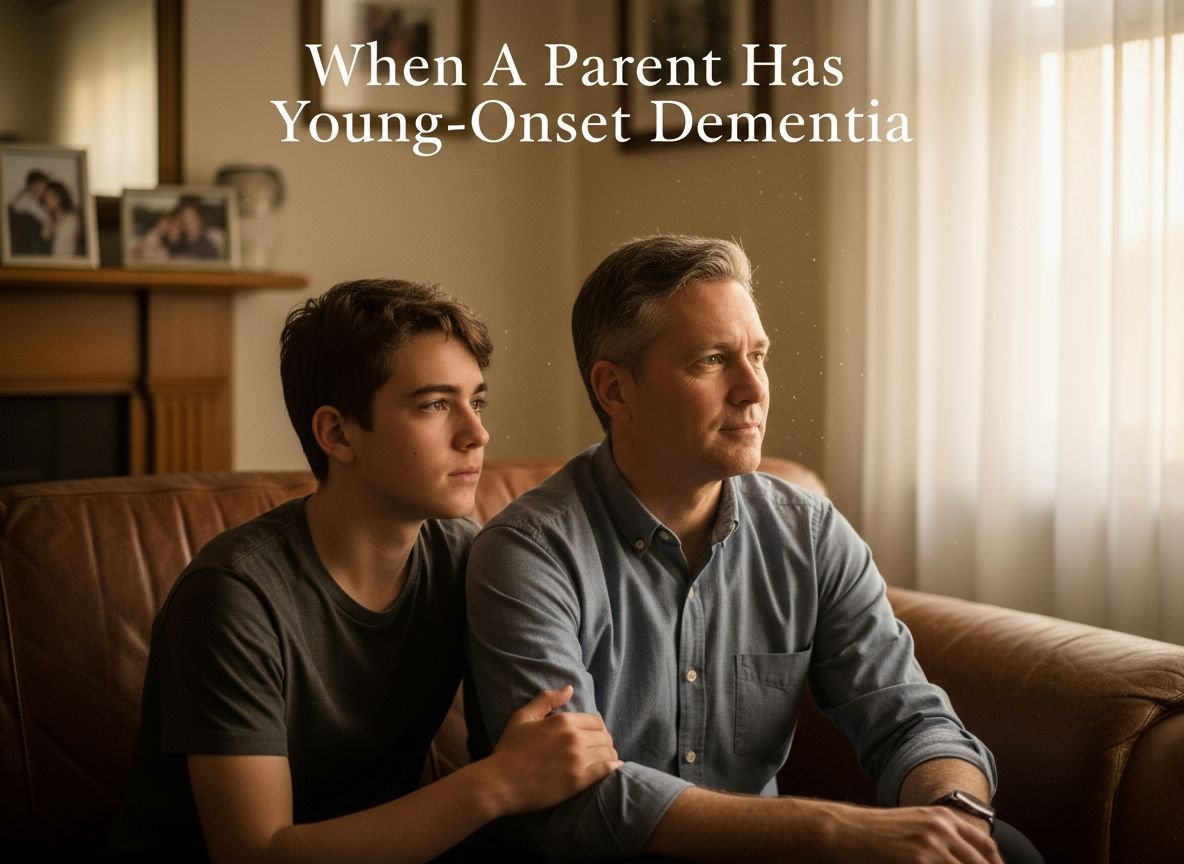
Young onset dementia (YOD) is a life-altering condition. It affects the entire family. When a parent is diagnosed with YOD, it can be especially difficult for children and young adults.
This guide offers information, support, and resources for young people living with a parent with YOD.
What is Young Onset Dementia?
Young onset dementia is dementia that begins before the age of 65. [1] It is less common than dementia in older adults. Still, it affects a significant number of people.
Globally, about 3.9 million people between 30 and 64 live with YOD. [4]
There are several types of YOD.
The most common are Alzheimer’s disease, vascular dementia, and frontotemporal dementia (FTD). [4]
Symptoms can vary. They often include more than just memory loss. Behavioral changes, communication difficulties, and problems with planning are also common. [1]
| Type of Dementia | Worldwide Prevalence (per 100,000 people) |
|---|---|
| Alzheimer’s Disease | 41.1 |
| Vascular Dementia | 14.9 |
| Frontotemporal Dementia | 2.3 |
Source: Hendriks et al., 2021 [4]
The Unique Challenges for Young People
Living with a parent with YOD presents unique challenges. Young people often face emotional, social, and educational difficulties. Many feel isolated and misunderstood. [1]
Emotional and Psychological Strain
The emotional toll can be immense. Young people may experience anxiety, depression, and anticipatory grief. [2] This is grief for the future losses they know are coming. The unpredictable nature of the illness adds to the stress. [1]
Educational Impact
School life can be significantly affected. Young people may have trouble concentrating. They might have poor attendance or difficulty completing homework. [1] Some even face bullying from peers who do not understand the situation. [1]
Social Isolation
Many young people feel alone. They may withdraw from friends and social activities. [3] The stigma associated with dementia can make it hard to talk about what is happening at home. [2] This can lead to feelings of embarrassment and isolation.
Changing Family Dynamics
When a parent has YOD, family roles often change. Young people may take on caring responsibilities. This is a significant shift from the typical parent-child relationship. [2]
This role reversal can be difficult. It can strain family relationships. Communication may become challenging. Siblings might have different ways of coping, which can also create tension. [2]
Coping Strategies for Young People
There are ways to cope with the challenges. It is important to find healthy strategies. These can help manage stress and maintain well-being.
- Seek information. Learning about YOD can help you understand what is happening. It can also prepare you for the future. [2]
- Build a support network. Connect with friends, family, or a trusted adult. You do not have to go through this alone. [2]
- Find healthy outlets. Engage in hobbies and activities you enjoy. This can help you relax and de-stress.
- Stay connected. Find new ways to connect with your parent. This could be through music, art, or simply spending quiet time together.
Finding Support
Support is available for young people and families affected by YOD. There are organizations that offer resources, support groups, and a sense of community.
Lorenzo’s House
Lorenzo’s House is a global, virtual organization. It is dedicated to supporting families affected by YOD. They offer free programs for children and young adults. [5]
- MATCH: Connects you with a peer who understands your situation.
- CLUBS: Provides virtual spaces to share stories and find community.
- SUMMIT: A youth-led event to educate and empower.
Other Resources
- Alzheimer’s Association: Offers support groups and educational resources.
- Young-Onset Dementia Education & Support (YES): Provides education and support for families.
- Young Dementia Network: Offers resources specifically for people affected by YOD.
A Message of Hope
Living with a parent with YOD is challenging. But you are not alone. There is a community of people who understand. There are resources available to help you. By seeking support and finding healthy ways to cope, you can find strength and resilience.
References
[1] Sikes, P., & Hall, M. (2018). The impact of parental young onset dementia on children and young people’s educational careers. British Educational Research Journal, 44(4), 593–607. https://pmc.ncbi.nlm.nih.gov/articles/PMC6099504/
[2] Blake, C., & Hopper, L. (2022). Childhood perspectives of parental young onset dementia: A qualitative data synthesis. Dementia, 21(4), 1336–1353. https://journals.sagepub.com/doi/full/10.1177/14713012221077531
[3] Aspö, M., Visser, L. N. C., Kivipelto, M., Boström, A.-M., & Seiger Cronfalk, B. (2023). Family Members’ Experiences of Young-Onset Dementia: Becoming Responsible Yet Feeling Powerless. Journal of Multidisciplinary Healthcare, 16, 2379–2390. https://pmc.ncbi.nlm.nih.gov/articles/PMC10441645/
[4] Hendriks, S., Peetoom, K., Bakker, C., van der Flier, W. M., Papma, J. M., Koopmans, R., Verhey, F. R. J., de Vugt, M., & Köhler, S. (2021). Global Prevalence of Young-Onset Dementia: A Systematic Review and Meta-analysis. JAMA Neurology, 78(9), 1080–1090. https://pmc.ncbi.nlm.nih.gov/articles/PMC8290331/
[5] Lorenzo’s House. (n.d.). We Bring Light to Younger-Onset Alzheimer’s and other dementias. Retrieved November 17, 2025, from https://lorenzoshouse.org/