Could a simple task like drawing a clock reveal signs of dementia?
The clock drawing test is a surprisingly effective and widely used screening tool for cognitive impairment. It provides a quick snapshot of a person’s cognitive abilities, including memory, executive function, and visual-spatial skills.
This article explains what the clock drawing test is, how it is administered, and what it can tell us about a person’s brain health.
What is the Clock Drawing Test?
The clock drawing test is a simple paper-and-pencil test that can be administered in just a few minutes. The person is asked to draw a clock, put in all the numbers, and then set the hands to a specific time, often “10 past 11.”
The test is not a diagnostic tool for dementia, but it is a highly effective screening tool. An inability to draw a normal clock is a strong indicator that a person may be experiencing cognitive decline and needs further evaluation.
What Does the Clock Test Measure?
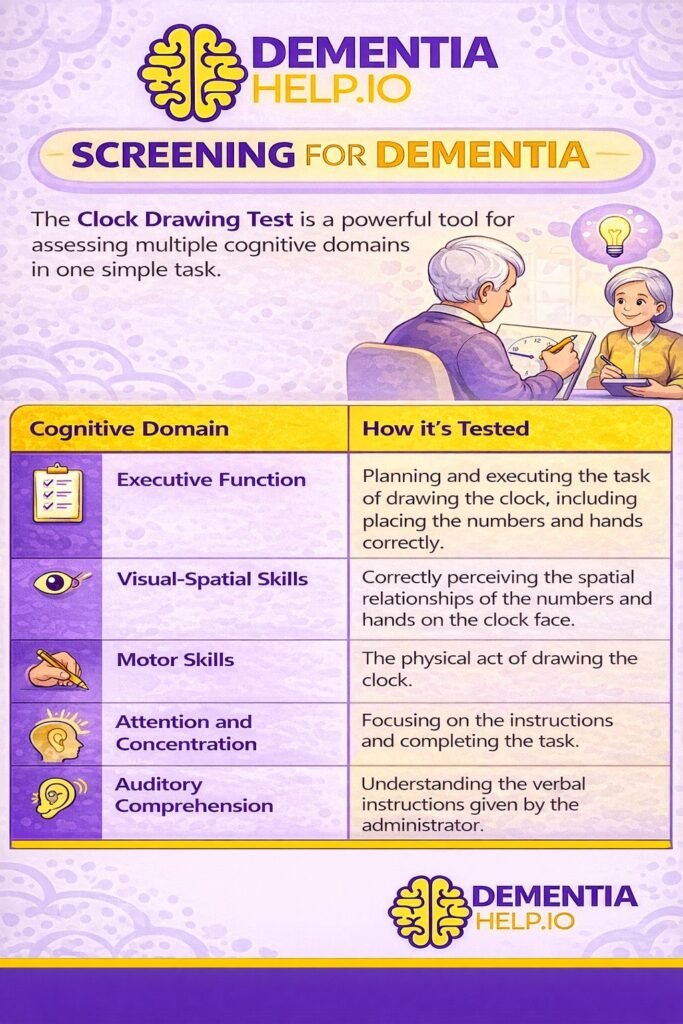
The beauty of the clock drawing test is its ability to assess multiple cognitive domains at once.
How is the Clock Drawing Test Scored?
There are several scoring systems for the clock drawing test, ranging from simple to complex. However, many clinicians use a simple method: a perfect clock is normal, and any imperfection is a sign of possible cognitive impairment.
Common errors that may indicate cognitive decline include:
- Missing numbers or incorrect number sequencing.
- Incorrect placement of the numbers on the clock face.
- Wrong time shown by the hands.
- Inability to draw the clock hands or drawing them incorrectly.
Why is the Clock Drawing Test So Useful?
The clock drawing test is a valuable tool for several reasons:
- It is quick and easy to administer. It requires minimal equipment and can be done in almost any setting.
- It is sensitive to early changes. The test can often detect cognitive changes earlier than some other screening tools.
- It is well-accepted by patients. Most people do not find the test to be intimidating.
While the clock drawing test is a powerful screening tool, it is not a substitute for a comprehensive medical evaluation. If you or a loved one has concerns about memory or cognitive function, it is essential to see a doctor for a full assessment.
This article is for informational purposes only and does not constitute medical advice. Always consult with a qualified healthcare professional for any health concerns or before making any decisions related to your health or treatment.