Caring for a spouse with dementia is a journey of love, commitment, and immense challenge.
As your partner’s cognitive, emotional, and physical abilities change, your role evolves from spouse to primary caregiver, a transition that can be isolating and emotionally taxing.
You are not alone in this experience. Millions of spouses across the country are on a similar path, and many have found a vital source of strength and resilience in dementia caregiver support groups.
This article explores the unique difficulties faced by spousal caregivers, the proven benefits of joining a support group, and the various types of support available.
We will also provide practical guidance on how to find the right group for you, empowering you to find a community that understands and shares your journey.
The Unseen Burden: Unique Challenges for Spousal Caregivers
While all dementia caregivers face significant stress, spouses often experience a unique set of emotional, physical, and financial challenges.
The intimate bond of marriage undergoes a profound transformation, leading to a distinct form of grief and loss even while the person with dementia is still present. Research highlights the specific burdens that spousal caregivers carry.
A 2024 study published in BMC Geriatrics found that 73.2% of spousal caregivers of people with dementia have at least one chronic health condition of their own [1].
The constant stress of caregiving can exacerbate existing health problems and contribute to new ones. The study also revealed that as the number of a caregiver’s health conditions increased, their stress levels rose, and their social networks shrank.
| Caregiving Impact Area | Key Statistics and Findings |
|---|---|
| Health of Caregivers | 73.2% of spousal caregivers have at least one chronic health condition of their own [1]. |
| Financial Strain | 70% of the total lifetime cost of dementia care is borne by families, often through out-of-pocket expenses and lost income [2]. |
| Time Commitment | In 2024, unpaid caregivers provided over 19 billion hours of care, valued at more than $413 billion [2]. |
| Emotional Toll | Spousal caregivers report twice the emotional, financial, and physical difficulties compared to caregivers of people without dementia [2]. |
The Well Spouse Association notes that spousal caregivers often provide more intensive care with less outside help compared to other family caregivers [3].
This can lead to a significant decline in the caregiver’s own well-being. The financial strain is also a major factor, as one or both partners may have to stop working, leading to a loss of income at a time when medical and care-related expenses are rising.
The Power of Shared Experience: Why Support Groups Work
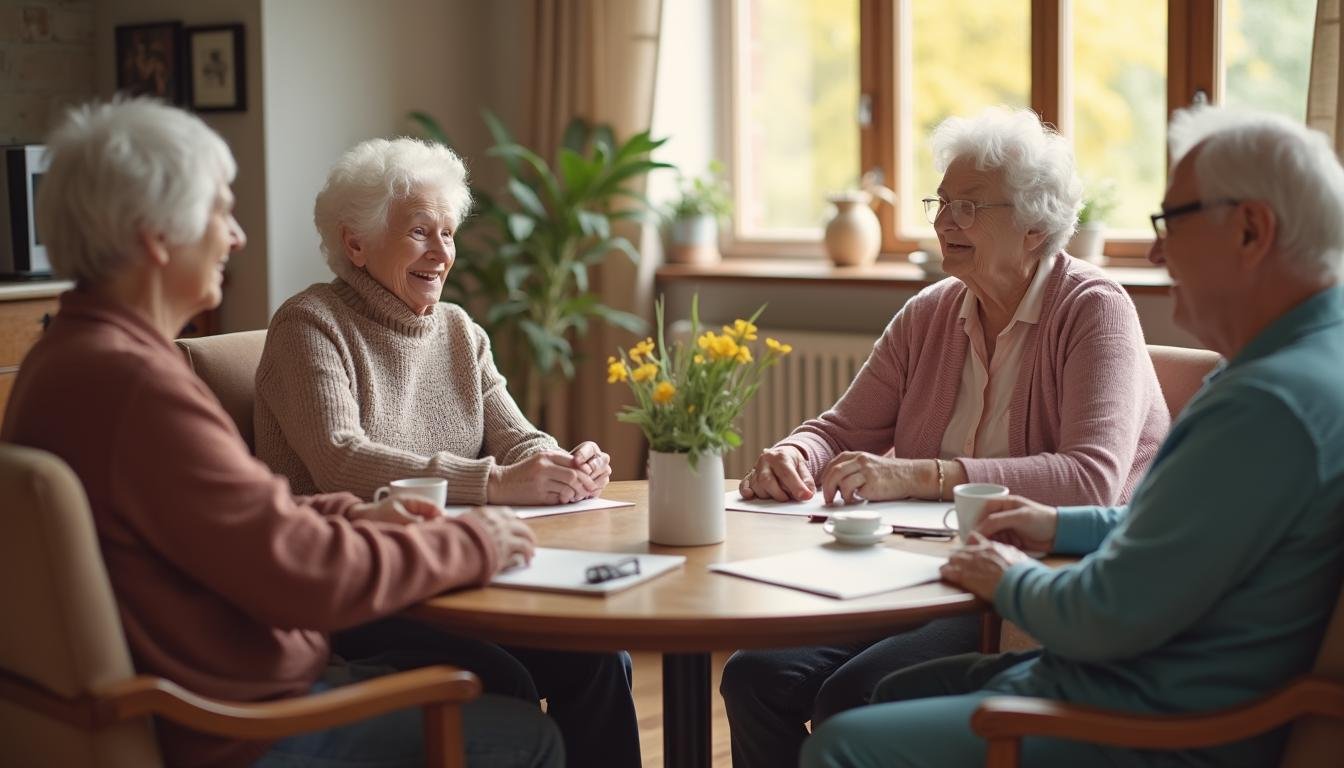
Amidst the daily demands of caregiving, it is easy to feel isolated. A dementia caregiver support group provides a safe and confidential space to connect with others who truly understand what you are going through.
Research has consistently shown the effectiveness of support groups in reducing caregiver burden and improving overall well-being.
A study on support groups for dementia caregivers found that they are a well-known resource, with a 70% awareness level among family caregivers [4].
The study also highlighted that the most important quality of a support group, according to caregivers, is the opportunity for an intensive exchange of experiences with frankness and honesty.
This shared understanding is the cornerstone of a successful support group.
Key Benefits of Joining a Support Group:
- Reduces Feelings of Isolation: Connecting with other spouses on a similar journey can alleviate the profound sense of loneliness that often accompanies caregiving.
- Provides Emotional Validation: Sharing your frustrations, fears, and sorrows with a group that understands can be incredibly validating. It reminds you that your feelings are normal and justified.
- Offers Practical Advice and Information: Group members often share practical tips and creative solutions for dealing with the day-to-day challenges of dementia care.
- Improves Coping Skills: Learning from the experiences of others can help you develop more effective coping strategies for managing stress and difficult behaviors.
- Empowers You to Be a Better Caregiver: By taking care of your own emotional needs, you can be a more patient, compassionate, and effective caregiver for your spouse.
Finding the Right Fit: Types of Dementia Support Groups
Support groups come in various formats, and finding the right one for your needs is essential. The Alzheimer’s Association and other organizations offer a wide range of options to accommodate different preferences and circumstances [5].
In-Person Support Groups
Traditional in-person groups provide face-to-face interaction, which many people find comforting. These groups often meet at local community centers, hospitals, or places of worship. The personal connection and sense of community can be a powerful antidote to isolation.
Virtual and Online Support Groups
For those who have difficulty leaving the house or prefer the convenience of connecting from home, virtual support groups are an excellent option.
These groups meet online via video conferencing platforms like Zoom. They offer the same peer support and expert guidance as in-person groups, with the added flexibility of being accessible from anywhere with an internet connection.
Online Forums and Message Boards
Online communities like the Alzheimer’s Association’s ALZConnected offer 24/7 support [6].
These message boards allow you to post questions, share your experiences, and connect with a large community of caregivers at any time of day or night.
This can be particularly helpful for those who need support during off-hours or have specific questions they want to ask a broader audience.
Disease-Specific and Specialized Groups
Some support groups are tailored to the specific type of dementia your spouse is living with, such as Lewy body dementia or frontotemporal dementia.
There are also specialized groups for adult children caregivers, spouses, and those caring for individuals in the early or late stages of the disease.
These groups can provide more targeted advice and a deeper level of understanding from others in a similar situation.
How to Find a Dementia Caregiver Support Group
Taking the first step to find a support group can feel like a big one, but there are many resources available to help you connect with the right group.
A study found that while 70% of caregivers are aware of support groups, 45% do not know where to find their nearest one [4].
Here are some practical ways to find a group that fits your needs:
- Alzheimer’s Association: The Alzheimer’s Association is a leading resource for finding local and virtual support groups. You can use their online search tool or call their 24/7 helpline at 800.272.3900 to find a group near you [5].
- Family Caregiver Alliance: The Family Caregiver Alliance offers a variety of online and in-person support groups, as well as a wealth of information and resources for caregivers. Their website has a tool to help you find services in your state.
- Your Doctor or a Social Worker: Your primary care physician, a neurologist, or a hospital social worker can often provide referrals to local dementia support groups.
- Local Area Agency on Aging: Every state has an Area Agency on Aging that provides resources and support for older adults and their caregivers. They can connect you with local support groups and other services.
- Online Searches: A simple online search for “dementia caregiver support group near me” can yield many results. Be sure to look for groups that are facilitated by trained professionals or have a clear set of guidelines.
You Are Not Alone
Caring for a spouse with dementia is a profound act of love, but it is not a journey you have to take by yourself.
Support groups offer a lifeline of understanding, empathy, and practical advice.
By connecting with other spouses who are walking a similar path, you can find the strength, resilience, and emotional support you need to care for your partner and for yourself.
Taking that first step to join a group is an investment in your own well-being and a testament to your commitment to your spouse.
References
[1] Sabatini, S., et al. (2024). Health conditions in spousal caregivers of people with dementia and their relationships with stress, caregiving experiences, and social networks: longitudinal findings from the IDEAL programme. BMC Geriatrics, 24(1), 171. https://bmcgeriatr.biomedcentral.com/articles/10.1186/s12877-024-04707-w
[2] Alzheimer’s Association. (2024). 2024 Alzheimer’s disease facts and figures. Alzheimer’s & Dementia, 20(5), 1597-1689. https://www.alz.org/alzheimers-dementia/facts-figures
[3] Well Spouse Association. (n.d.). About Us. https://wellspouse.org/
[4] Gräßel, E., et al. (2010). Support groups for dementia caregivers – Predictors for utilisation and expected quality from a family caregiver’s point of view: A questionnaire survey PART I. BMC Health Services Research, 10, 219. https://pmc.ncbi.nlm.nih.gov/articles/PMC2922206/
[5] Alzheimer’s Association. (n.d.). Support Groups. https://www.alz.org/help-support/community/support-groups
[6] Alzheimer’s Association. (n.d.). ALZConnected. https://www.alz.org/help-support/community/alzconnected